3 September 2026
Wellington Jazz Festival marks its 30th birthday this year. We catch up with one of the event’s founders, Simon Bowden, to take a look back over the years.
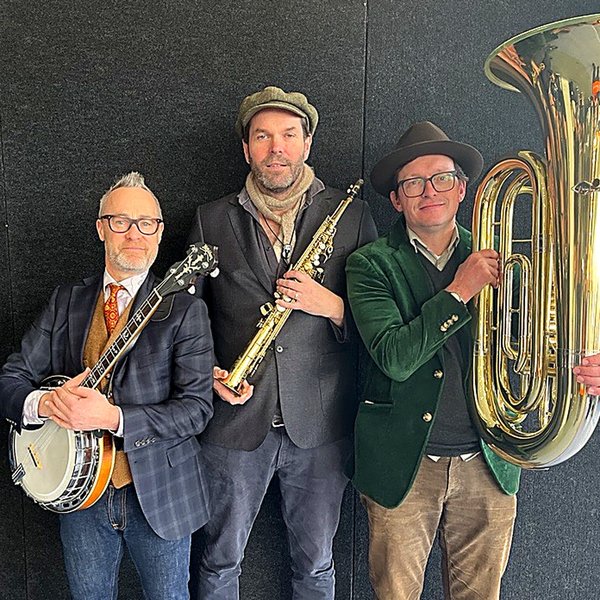 Simon Bowden (left) with Swing Gigolos, Lucien Johnson(centre), and Dan Yeabsley
Thirty years ago Simon was a new graduate from music school and, together with a group of equally passionate musicians, he wanted to explore new sounds in jazz and create opportunities for Aotearoa musicians.
“Jazz back then was very much still influenced by the American style, and we wanted to create our own sound. To do that you need a healthy community and opportunities to listen to each other and try things out.
“We were playing in different bands and gigging a lot – it was back in the days when you could make enough from gigs to put yourself through university – but we did want to explore our own sound and we realised there was no industry unless we created it and that still applies today. The community then grows and the artform grows with it.”
The Wellington Jazz Collective was formed, and the first Wellington International Jazz Festival was presented in 1997 with six concerts held over five days at what is now the Intercontinental with about 200 people at each gig. Simon, Dave Leahy, and Jeff Henderson were the driving force behind the Festival.
“We were all on the dole and did everything ourselves. My brother came down from Palmerston North and ran the sound on his PA he used for his rock band.
“Dave and I worked really closely on it, and I recall a week before the festival he went overseas to tour with Saxcess saying ‘there’s just a few little things to finish off’. He came back and said it went so well he might head off every year a week before the festival – I was nearly dead … those ‘few little things’ saw me working around the clock with lots of early mornings and late nights.”
The festival ran for five years with Simon at the helm. “It was a festival for musicians by musicians, and we definitely had plenty of critics. People stormed out!
“We were really clashing with some in the jazz scene at the time – I remember getting a fax message from a mainstream musician complaining their band wasn’t included and suggesting that a better name for the festival would be Simon Bowden and Friends Crazy Jazz Adventures.
“We had William Parker Jazz Big Band play which was basically an improvised orchestra and people were very upset we used the term ‘big band’.
“We wanted to be progressive, and we worked on the idea that no-one would have heard of the bands on the programme and that was exciting.”
And Simon, a guitarist and banjo player, adds he played in every festival in those early years. “I would be playing at one venue and at the break I’d dash across to another venue to do an introduction or to thank a band and then dash back to keep playing. It was crazy.”
Over the years the festival drew on the Wellington music scene for its crew and Simon recalls some fun pop-up promotions run by the Jazz Fiends – “they’d slip into another show – I know we did this at a performance by the Royal New Zealand Ballet – and they would hide among the seats with their instruments, then would pop up, play a flurry of music and run out.”
Simon was proud of being able to offer a platform for Aotearoa New Zealand musicians and the commissioning of new works was an annual feature of the festival which has continued. In the early days commissioned artists included Mike Nock, Steve Lacy and Steve Cournane.
“We wanted to provide a framework for musicians to write new works and it’s fantastic that has continued.”
The 2000 Festival was a highlight for Simon. “We had taken over a venue on the waterfront and partnered with Matterhorn, so we had the headline acts in the main space, while upstairs was ‘new jazz’. It was fantastic having it all in one venue. I still don’t know how we got the fire permit – and we did have to evacuate the building one night during the festival!
“That was also the year we ended up being included in the Lonely Planet guide. At the time, Wellington really was at the pinnacle of gaining an arts reputation and the Festival was part of that story.”
Simon says the Festival was run on a shoestring, with very limited resources. He ran the event until 2001 when he went on to set up The Arts Foundation. The following years saw a number of different directors and iterations until the New Zealand International Arts Festival chief executive David Inns came knocking.
“I had been talking to David, and he was looking for an additional event to sit alongside the biennial arts festival and provide more opportunities for sponsors. We got talking and in the end we sold the event to NZIAF for $1 – I’m still not sure if I ever received that dollar!
“The only real asset we had was the website url www.jazzfestival.co.nz and it was a wonderful feeling to hand that over and know that the festival would continue and would have the opportunity to grow further than we could take it.
“I don’t think it would have survived if David and the Festival hadn’t come along. It had become difficult to run with such limited resources.
“That first year [2009] under the NZIAF banner was incredible with the likes of Tomasz Stańko, Roberto Fonseca and Mingus Big Band, and created a single level jazz club inside Wellington Town Hall – it was fantastic.”
And as for this year’s festival, Simon says he’s looking forward to Te Ao Kōhatu – Hikurangi Schaverien-Kaa, featuring this year’s newly commissioned piece, and to experiencing the range of Aotearoa New Zealand musicians playing at venues across the city.
“It’s so great the festival is celebrating its 30th birthday this year – I’m really proud of what we started and how much it has grown. It’s had a huge impact on my life.”
Disclaimer: ARTicle includes a variety of content, including interviews, editorial commentary and links to external sources. The views expressed by interviewees, editors and external sources are their own and do not necessarily reflect those of Tāwhiri, its team, or its partners.