9 July 2026
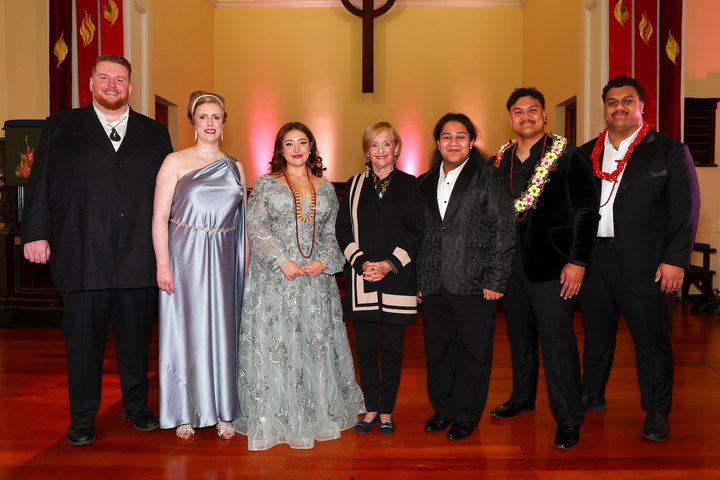
It's been a long journey for the six incredibly talented Finalists in the 2026 Kiri Te Kanawa Song Quest.
We grabbed a few minutes with Cecily Shaw, brothers Faamanu and Jordan Fonoti-Fuimaono, Samuel Downes, Samuel Mataele, and Sarah Mileham on Sunday night to ask each of them to tell us something about themselves which may surprise people. Read on to find out who used to figure skate, and who has been taking heavy metal 'scream' lessons!
Cecily Shaw (mezzo soprano, 32): “I’ve been having lessons to learn heavy metal screaming. I haven’t mastered it yet but I’m trying and I’m better at opera. There are a few techniques, so you do it in a healthy way. I love anything edgy – I’m an edgy teen in a 32-year-old body!”
Faamanu Fonoti-Fuimaono (baritone, 26): “I enjoy weightlifting and my max bench press is 185kg. I once went viral on Tik Tok when I broke a weight bench doing a workout to prove that the gym I went to didn’t have weights heavy enough for me!”
Jordan Fonoti-Fuimaono (tenor, 25): “My favourite artist is Paramore. I think people might be a bit surprised to hear that.”
Samuel Downes (tenor, 29): “I used to sing bass and only switched to tenor fairly recently – it’s just where my voice wanted to go. I’m enjoying the different repertoire. And I may be a big guy, but I’m a real softie.”
Samuel Mataele (countertenor, 19): “I used to be a figure skater [on ice] and even competed in Australia. I was when I was about 13 and I stopped singing for a while. My mum asked me why I did figure skating instead of continuing to sing and I said, ‘I don’t think I will have a career as a singer’ … which is crazy as I definitely wasn’t going to have a career as a figure skater.”
Sarah Mileham: “I sang tenor in school choir which seems so strange now that I’m singing soprano. Singing is my whole life, so I don’t really do anything else.”
Tickets for the Kiri Te Kanawa Song Quest Grand Final Gala on Saturday 11 July are available HERE.
Disclaimer: ARTicle includes a variety of content, including interviews, editorial commentary and links to external sources. The views expressed by interviewees, editors and external sources are their own and do not necessarily reflect those of Tāwhiri, its team, or its partners.