9 November 2026
“A religious obsessive and an atheist walk into a theatre …”
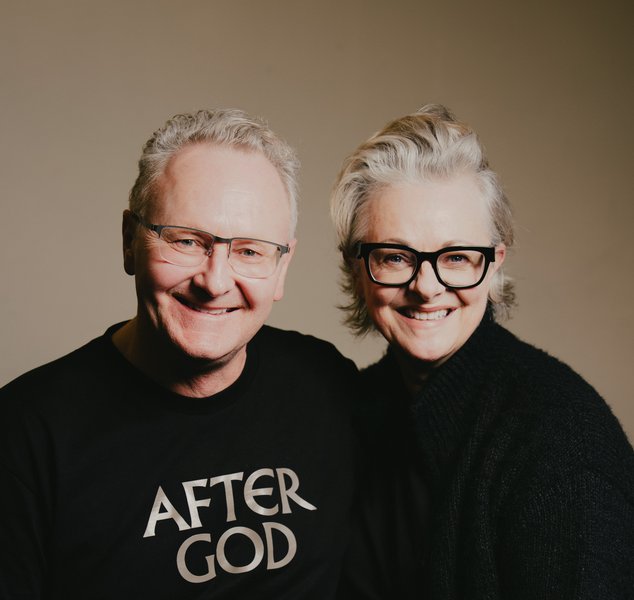
It sounds like the beginning of a joke, but it’s how Wellington creative couple Stuart McKenzie and Miranda Harcourt describe the theme of creating their latest play, After God.
 Ben Sarikaya
Currently playing at Circa Theatre, After God tackles theology, mortality and the apparently impossible quest to understand God, while finding plenty of room for humour, friendship and hope along the way.
At its heart, After God is a search for understanding – a search that for Stuart began in childhood. “My father was an Anglican minister and as a kid I told him I didn’t believe in God. He said ‘that’s ok, he still believes in you’. That was a dirty trick.
“It was a real challenge for my mother when I stopped going to church, but not for my father. My grandfather was an atheist and would have been shocked if he’d found out that his son was ordained.”
But taking Stuart’s own search for God out of his personal life and onto the stage was a journey which saw him travel from Wellington to Kathmandu, London and New York, talking to theologians, philosophers, cosmologists, Tibetan Rinpoches, taxi drivers, a singing nun and his own mother about belief, doubt, and hope.
“People consider politics, religion, sex and money as the great taboos in conversation,” Stuart says. “But religion is part of how people understand identity and meaning in the world. The fascination lies in the quest to find something greater than ourselves, and what that might mean for us.”
It is fertile territory for Stuart, whose bookshelves, Miranda jokes, are “crammed with the writings of theologians”. Among them are works by theologian Mark C. Taylor an American theologian who would become a critical character in the play.
Stuart reflects “I’ve been reading Mark’s books for around 40 years - his book Erring: A Postmodern A/Theology taught me to look for the sacred where it is least obvious.” Last year, Stuart emailed Mark to ask to interview him for a stage play. “I wanted to find out what happens when the God you’ve inherited no longer makes sense. What I found was friendship.”
Mark is also acknowledged in the play’s subtitle ‘Hope is an act of defiance’ – a quote from Mark’s book The Moment of Complexity: Emerging Network Culture.
“He’s an esteemed thinker and I look up to him hugely, and he’s become a lovely friend,” Stuart says. The play, he suggests, could also be seen as the story of this developing friendship.
 credit Stephen A’Court
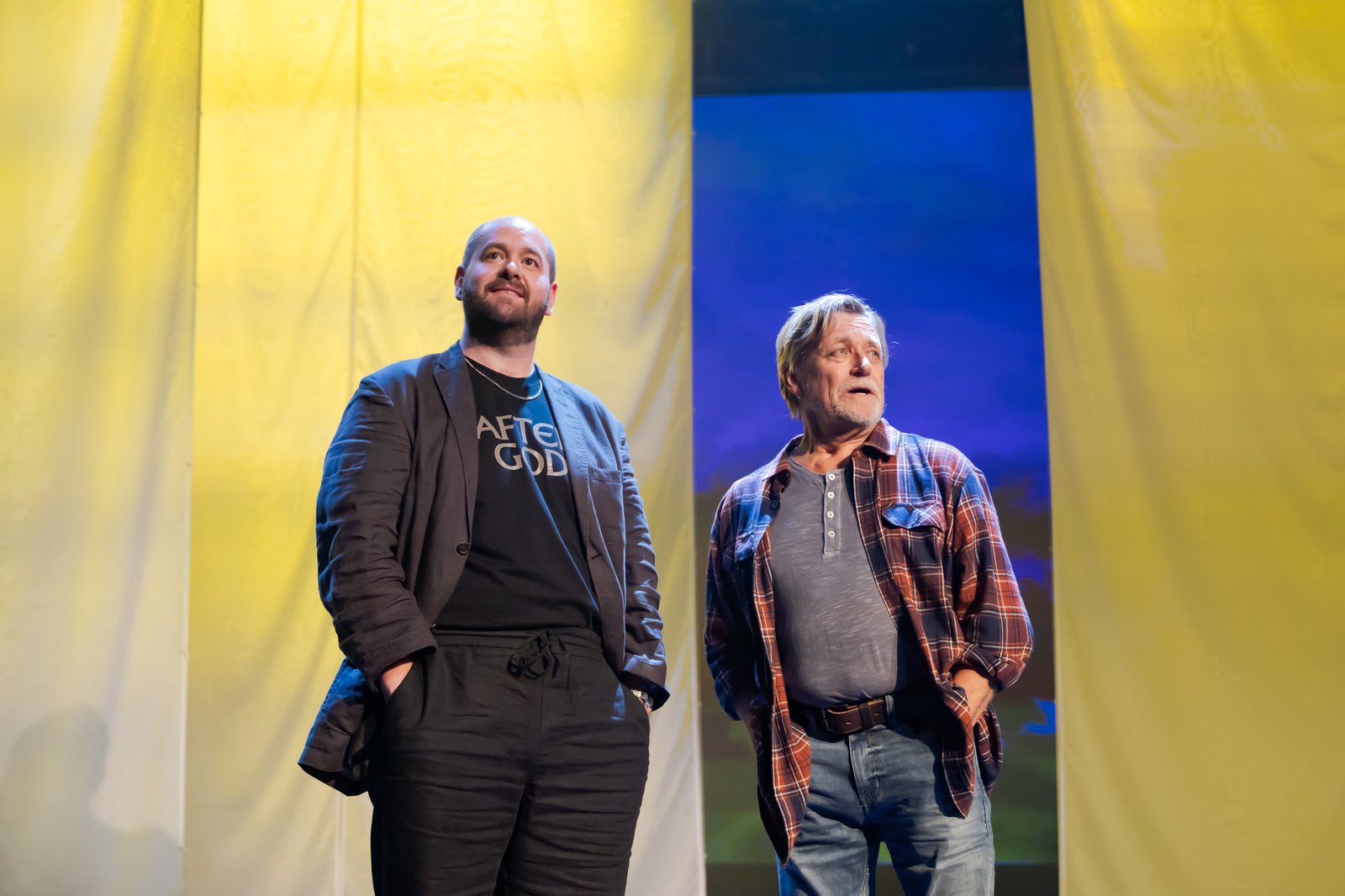
Andrew Paterson (left) as Stuart McKenzie, and Michael Hurst as Mark C. Taylor in After God
Miranda, who co-directs After God, admits she was initially cautious about Stuart’s idea for this latest project. Their earlier works Transmission and Transmission Beta dealt with Covid, an experience shared in some way by everyone, and which featured interviews with protagonists in New Zealand’s Covid response.
“Religion and theology are different. People hold strong views, and for many audience members After God may be their first encounter with this kind of thinking,” Miranda says.
The challenge became how to make complex ideas something audiences could not only think about, but understand, and while it references Nietzsche, Derrida, Plato, Heidegger, and Martin Luther, audience members don’t need to know or understand theology to experience the play.
“We wanted the play to be emotional and affecting, and at the same time to be surprising and entertaining. We’ve been delighted and thrilled by the response to the play – people are coming out with a sense of wonder, of discovery, and of hope.”
Establishing a ‘safe place’ for audience members to engage with the play is signalled at the start with conversations with an Uber driver and then with Stuart’s mother, Pam.
“These conversations give an emotional anchor to ideas that might otherwise become a bit ‘pointy-headed’,” Stuart says.
“The first half of After God contains many of the ideas, but the second brings the rub: mortality. The intention is to take audiences towards the brink of the unknown without pretending to take them beyond it. It starts with the head and ends with heart.”
While Stuart had mulled the idea of After God over for many years, it was while on the island of Hydra in Greece that the bulk of the writing took place.
Miranda was working on Brad Pitt’s film The Riders, giving Stuart the perfect opportunity to concentrate solely on writing.
“It was the first time I have essentially had a writer’s residency,” he says. When Miranda left for filming elsewhere, he stayed behind on Hydra.
The island has no cars, only donkeys, and Stuart describes it as bleak and barren. He visited monasteries, sat looking at artworks, walked, thought and wrote. After four or five weeks he had a draft he could make sense of. “So, I guess I have to say ‘thanks Brad!’”
While on Hydra, Stuart’s mother, Pam, died and her death found its way into the work.
That intersection between the personal and the documentary has long been familiar territory for Stuart and Miranda who have championed verbatim theatre for more than 40 years and their joint creative practice stretches back to their play Flowers in My Mother’s Garden which featured at the 1998 New Zealand International Festival of the Arts.
“We turn the lens on ourselves which means the works are deeply personal and exposing.” Both Stuart and Miranda are characters within After God and Stuart admits some revelations mean often people find it hard to talk to him afterwards.
“In fact, the initial draft had less of me in it,” Stuart says. “But feedback from those who initially read the play was that it was a quest story and they wanted more of the Stuart character.”
Miranda adds that verbatim theatre is an unusual theatrical form, but one which has a long history and draws on the tradition of the ‘everyman’ and his journey. “Stuart really is the guide for the audience, and he is played by four members of the cost who represent different aspects of him.”
In After God, everything heard on stage comes from interviews and conversations at which Stuart was the catalyst, all woven together into a theatrical narrative.
Five actors play 35 characters, with no costume changes and very few props. Instead, changes in voice and manner signal the shifts from one person to another.
“We’ve been blessed by an incredible cast and crew,” says Stuart. “Some crew members – including set designer Mark McEntyre and sound designer Chris Ward – have worked with us for a long time, while others are new to working with us, including all the cast.”
Cast member Andrew Paterson plays Stuart McKenzie throughout the play with three other cast members (Roy Clark, Kali Kopae and Tara Canton) also playing Stuart at different times, showcasing different elements to his character. Well-known actor Michael Hurst rounds out the cast list and plays Mark C. Taylor. It is amazing how things turned out when casting the play,” Miranda says. “When Michael and Stuart first met on Zoom, they just ignited.”
Stuart adds that his text message to Michael offering him the role was “the last text he cleared before starting a 10-day retreat … what a great way to prep for this role.”
While theology, religion and the meaning of life can be weighty subject matter, Stuart and Miranda also describe the play as an absurdist comedy, and a contemporary riff on Waiting for Godot. The pursuit of God, Stuart acknowledges, “has its own kind of crazy energy”.
And for Stuart personally, the journey to create After God has changed some of his thinking about God.
“The idea of searching for God is absurd,” Stuart says, “but for me the search continues.”
After God is at Circa Theatre until 14 November.
“After God is never thick, yet always fast, the dialogue is full of wisdom, worry, humour, and heart.”. – Simon Sweetman
Disclaimer: ARTicle includes a variety of content, including interviews, editorial commentary and links to external sources. The views expressed by interviewees, editors and external sources are their own and do not necessarily reflect those of Tāwhiri, its team, or its partners.