7 May 2026
Describing it as “uncovering a hidden story of our history”, filmmaker Tearepa Kahi (POI E: The story of our song, MURU) says his new film, SGT. HAANE, came about through a series of “happy accidents”.
The film traces the story of 28th Māori Battalion soldier Haane Manahi who leads a small band of B Company soldiers – all cousins – up a 300m cliff face in a surprise attack on an enemy post and changes the course of World War II in North Africa.
SGT HAANE weaves together dramatic reconstruction, intimate documentary testimony and rare wartime footage and had its world premiere in Rotorua on the 83rd anniversary of the event. The film is screening in cinemas now. We caught up with Tearepa to talk about bringing Haane Manahi’s story to the screen.
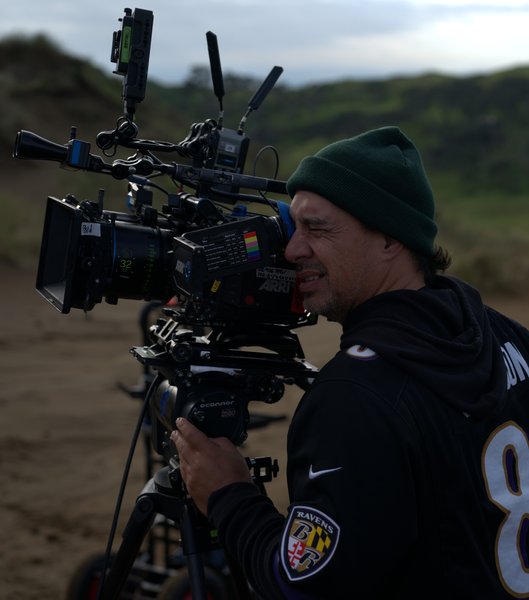
Fourteen months – from the first ‘cup of tea’ to the world premiere screening – is a very short time to make a film, but filmmaker Tearepa Kahi says the “planets aligned” to weave together the threads of a story of what happened one night in Tunisia 83 years ago. I ask Tearepa to share those initial stages.
“I knew about the men of the 28th Māori Battalion and after MURU came out Haane Manahi’s niece, Dr Donna Morrison approached Reikura (producer) and I about bringing his story to the screen.
“I was initially hesitant about making this film – there were others more qualified, by whakapapa, to tell the story. It’s such a historically significant story and I usually like to be in control of composing the narrative. With MURU there were lots of cups of tea with Tame (Iti) to develop the story, but with the story of Haane, there was no creative license to roam.”
The film centres on one night in Tunisia – 19 April 1943. The ancient rock fortress of Takrouna is teeming with enemy machine gun posts and heavy artillery, manned by an elite Axis force. Allied commanders call it impregnable. An assault from the base of the rock comes under enemy fire and Haane Manahi leads his group up the precipitous cliff face.
Moving through dense minefields and cactus groves in darkness, Haane takes out machine gun post after machine gun post – with grenades, with his bayonet, his bare hands. In the space of the night, he captures more than 300 prisoners, navigates enemy counter-attacks and protects a Tunisian civilian family sheltering in a cave beneath the battlefield.
General Horrocks, who witnessed the Allied North African campaign, would later say: "The greatest feat of courage I ever witnessed during the war".
Following the extraordinary feat at Takrouna, three Generals and a Field Marshal signed a recommendation for Haane Manahi to receive the Victoria Cross, but it was struck out by an anonymous British official and downgraded to a Distinguished Conduct Medal*.
Tearepa says initially he was tempted to tell “an Errol Morris style documentary exploring the anatomy of that downgrade, but after visiting his grave I opted to tell the story of what he actually did and those who were there with him.”
Happy Accident #1
“I had travelled to Ōhinemutu for a hui with Donna and my kids had come with me. They were outside playing with the other children and one boy called Haane who turned out to be a descendant of the famous soldier. I had this sudden lightbulb moment to connect Haane’s legacy with his descendants and that led to involving the family in telling the story.”
The film moves between two worlds – Ōhinemutu, Rotorua today and Tunisia in 1943. Descendants of B Company, 28th Maori Battalion talk about Haane and the other soldiers who were with him, while in Tunisia the battle for Takrouna plays out.
To cast those who play the characters in the dramatised segments, Tearepa sought out those he had worked with in the past or knew. “We weren’t auditioning for particular roles, we were creating a band of cousins, and I really wanted to find connection and whanaungatanga.”
The importance of passing the story through the generation is mirrored in Tunisia.
Happy Accident #2
Tearepa says going to Takrouna in Tunisia was “a leap of faith.
“I’d read a lot of military reports and I had seen what I thought were the important maps, but nothing could prepare me for what I would experience when I was actually there.
“And then came the biggest jaw-dropping moment ever. Takrouna is incredibly remote and we believed it was uninhabited. It was Ramadan and my guide went to see whether one of the locals could possibly provide some food for lunch for myself and our camera operator – I had said I was okay to fast, but he insisted it was a good thing to do as we could give a koha and support the family.
“What happened next was completely random and unplanned – our guide came to me and said ‘there’s a man I think you should talk to… I think he knows something about your story’. The man turned out to be Nizar Chhoubi – the grandson of Salah whose family Haane protected while war raged overhead.”
Nizar and his grandson Youssef feature in the film as the story of the siege unfolds. “We discovered that the Chhoubi family have preserved the memory of Man’hai (Manahi) and the Māori Battalion soldiers as if it happened today.
“Nizar’s lucid memory could see into the past: the position of every cannon, the footprints of every soldier, and above a doorway in the village, hidden for 80 years, a bayonet left behind by one of Haane’s men.”
And so Tearepa says, the film became the connection between the events of 19 April 1943 in Takrouna, Tunisia and the people who remember and honour what happened there.
Tearepa says the many moving moments making the film culminated in the filming of the ANZAC Day dawn service in Rotorua in 2025 – “the first year when there hasn’t been a living member of the Māori Battalion in the ranks. It now sits with mokopuna to fill the space, and the story lives on through descendants and future generations.
“There were so many extraordinary moments creating this film – it’s the first time I’ve made a film and felt like I was a passenger along for the ride.”
*Haane Manahi’s family campaigned for the Victoria Cross to be awarded posthumously and in 2007 Queen Elizabeth presented the Manahi family with the Sword of Valour in recognition of his bravery. The Sword of Valour is now traditionally presented to and held by the Chief of the New Zealand Defence Force symbolising the relationship between the military and iwi.
Disclaimer: ARTicle includes a variety of content, including interviews, editorial commentary and links to external sources. The views expressed by interviewees, editors and external sources are their own and do not necessarily reflect those of Tāwhiri, its team, or its partners.